
Things to Draw When You Don't Know What to Draw
Every artist hits this wall eventually. The sketchbook is open, the pencil is sharp, and your hand is just hovering over the page. Nothing comes. It’s one of the more frustrating creative experiences, mostly because it has nothing to do with skill. You know how to draw, you’ve drawn plenty of things before, and yet right now the page might as well be a locked door. You just don’t know what things to draw, and the longer you sit there, the more that not knowing seems to grow.
The odd thing is that this usually happens on the days with the most freedom. No assignment, no client, no theme to work from, just you and a blank page and however much time you’ve set aside. That kind of open ended freedom sounds nice in theory, but in practice it’s often what causes the block in the first place. Too many options can feel a lot like no options at all, and your brain, instead of picking one thing and running with it, tends to freeze up entirely rather than commit.
This post is a working list of things to draw when your mind goes quiet, along with a few reasons that blank feeling shows up so often in the first place. Some ideas are simple prompts you can start on in the next five minutes, no planning required. A couple lean on pure randomness, because sometimes the fastest way through a rut is to hand the decision to something outside your own head and just see what happens once you start moving the pencil.
Why the Blank Page Feels So Hard
Part of it comes down to choice overload. When you could draw literally anything, your brain has to sort through an endless mental list before settling on one idea, weighing each option against some vague sense of whether it’s “worth” the time, and that sorting process eats up the energy you’d rather spend actually drawing. Psychologists call this the paradox of choice, and it shows up just as much at the sketchbook as it does in a grocery aisle stacked with forty kinds of cereal.
Perfectionism plays a role too, and it’s a sneakier one because it doesn’t feel like perfectionism while it’s happening. A lot of artists quietly wait for a good idea before they let themselves start, as if the first mark on the page needs to justify the whole session, needs to be interesting enough or clever enough to earn the time spent. That standard is impossible to meet before you’ve drawn anything at all, so the waiting just continues, and the sketchbook stays closed a little longer.
Then there’s routine, which is a quieter cause but just as common. If you draw often, you probably have a default handful of subjects you return to without thinking, maybe eyes, hands, or the same character you’ve been refining for months. That’s not a bad habit on its own, repetition builds skill, but drawing the same things over and over eventually stops feeling like practice and starts feeling like a chore. Once a subject feels like homework, picking up the pencil at all gets harder, and the blank page starts to feel less like an invitation and more like a test.

Finding Ideas Right Where You Are
Look at What’s Already in the Room
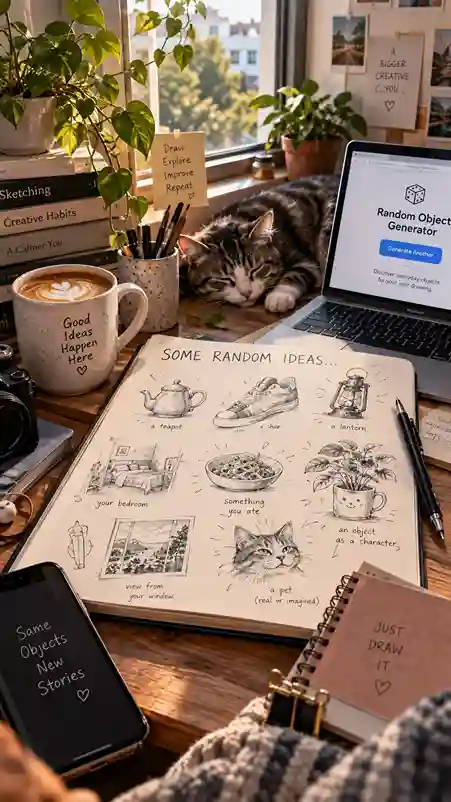
You don’t have to look far for a subject, and honestly, the closer the better. The mug on your desk, your shoes by the door, a plant that needs watering, the tangle of cords behind your monitor, these are all fair game, and drawing ordinary objects is genuinely good practice for shading, proportion, and perspective, since you can look at the real thing from any angle instead of relying on a flat photo. If you’d rather skip scanning the room yourself, a random object generator can hand you a subject in a couple of seconds, no browsing or deciding required, which is often the fastest way to get from staring at a blank page to actually making a mark.
Borrow From Memory Instead of a Reference
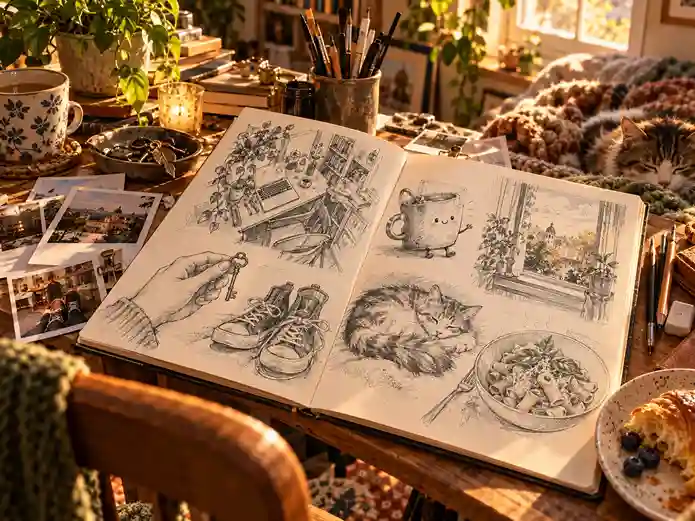
Drawing from memory is a different kind of exercise, and it’s a genuinely useful one that most people skip in favor of copying photos. Try sketching your childhood bedroom, a meal you had last week, or a face you saw on the train this morning. You’ll get details wrong, proportions will be off, and that’s fine, the goal isn’t accuracy, it’s training your brain to translate a mental image into marks on paper. That’s a skill reference photos can’t really teach you, since a reference does the observing for you and memory forces you to do it yourself.
Ready to rummage?
Spin up a batch of random objects right now — no sign-up, no waiting.
Quick Prompts to Get Your Hand Moving
- A cluttered desk from an unusual angle
- Your own hand holding something small
- A stranger’s shoes from a photo or memory
- An object turned into a tiny character with a face
- The view from your nearest window right now
- A pet, real or completely made up
- Something you ate in the last 24 hours
Pick any one of these prompts and start without overthinking the result. The goal is simply to get your hand moving—once you begin, the next idea usually comes much more easily.
Let Randomness Take the Decision Off Your Hands
There’s a reason so many artists keep a random prompt tool bookmarked next to their sketchbook. Once the subject is chosen for you, drawing stops being a decision and starts being a game, closer to a dice roll than a homework assignment.
You’re no longer asking whether an idea is good enough or interesting enough to bother with, you’re just reacting to whatever showed up on the screen, and that shift quiets the perfectionist voice a lot faster than sitting and brainstorming ever does, because there’s simply nothing left to overthink.
A random object generator works well for this because it’s specific without being complicated. One click gives you something concrete like a teapot, a shoe, or a lantern, rather than a vague theme you still have to interpret, and from there you decide how far to take it: realistic, cartoonish, part of a bigger scene with a whole story behind it. It’s a small tool, but it removes the one step that trips people up the most, deciding where to start, and once that step is gone the rest tends to follow on its own.
Good questions
Frequently asked
Start smaller than you think you need to. Pick one object in the room and commit to drawing it for ten minutes, no matter how boring it seems at first. Letting a tool choose the subject for you works too, since it skips the decision entirely and you just start moving your pencil instead of sitting there weighing options.
No, drawing random objects is real practice, and arguably some of the most useful kind. It builds observation, proportion, and shading, the same fundamentals that show up in more ambitious pieces later, just without the pressure of a big finished piece hanging over the session. Plenty of working artists still warm up this way, even after years of experience.
Set a short timer, five or ten minutes, and force yourself to pick the first idea that comes to mind once it goes off, even if it feels a little random or silly. The time limit matters more than the idea itself; it stops you from doubting yourself before you’ve even started, which is usually the real problem.
Keep it short and low pressure, five to fifteen minutes of sketching something ordinary, no erasing allowed and no aiming for a finished piece. Consistency matters far more than the subject you choose, so pick anything nearby, set a timer, and just start without waiting for the right idea to show up.
Yes, and in a fairly direct way. Drawing whatever comes up, rather than only your favorite subjects, forces you to practice things you’d normally avoid, unusual angles, unfamiliar objects, textures you don’t usually bother with. That variety builds skill faster than repeating the same comfortable subjects, since your hand and eye end up working through problems you’d otherwise never run into.
Anywhere from two to fifteen minutes works, depending on how much time you have and how loose you want to keep it. The point of a warm up isn’t a finished piece, it’s just getting your hand and eye working together before you move on to something bigger, so there’s no real benefit to stretching it out longer than that.