
How to Create a Story Using Random Objects
Every writer has stared at a blank page and felt nothing come out. You open a new document, maybe you even type a title, and then the cursor just sits there blinking at you like it’s waiting for something you don’t have yet. You know a story is in there somewhere, but how to create a story using Random Objects, the more convinced you become that you’ve simply run dry. That feeling isn’t a sign you’ve lost your creativity, it’s usually a sign you’re starting from the wrong end of the process.
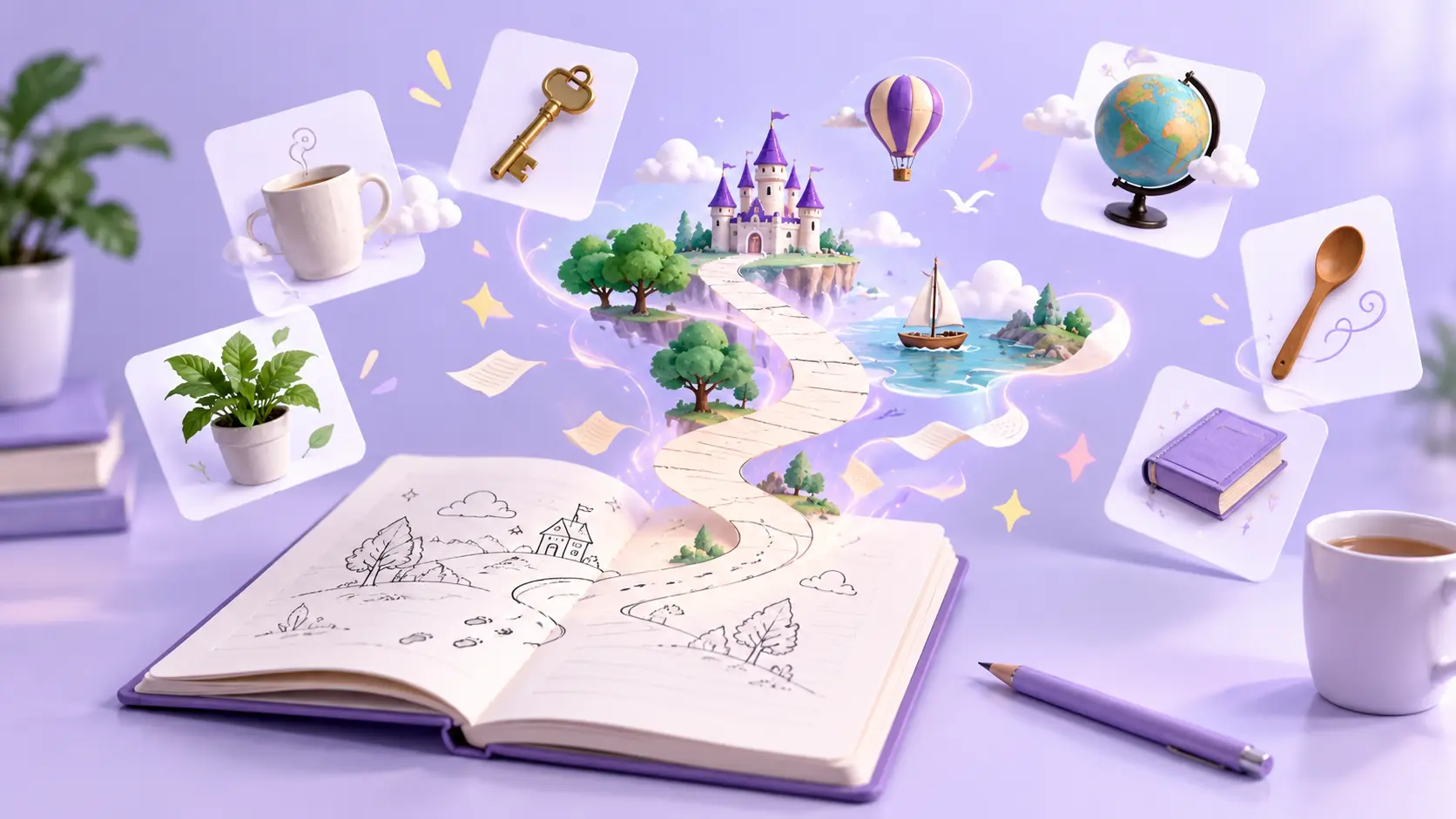
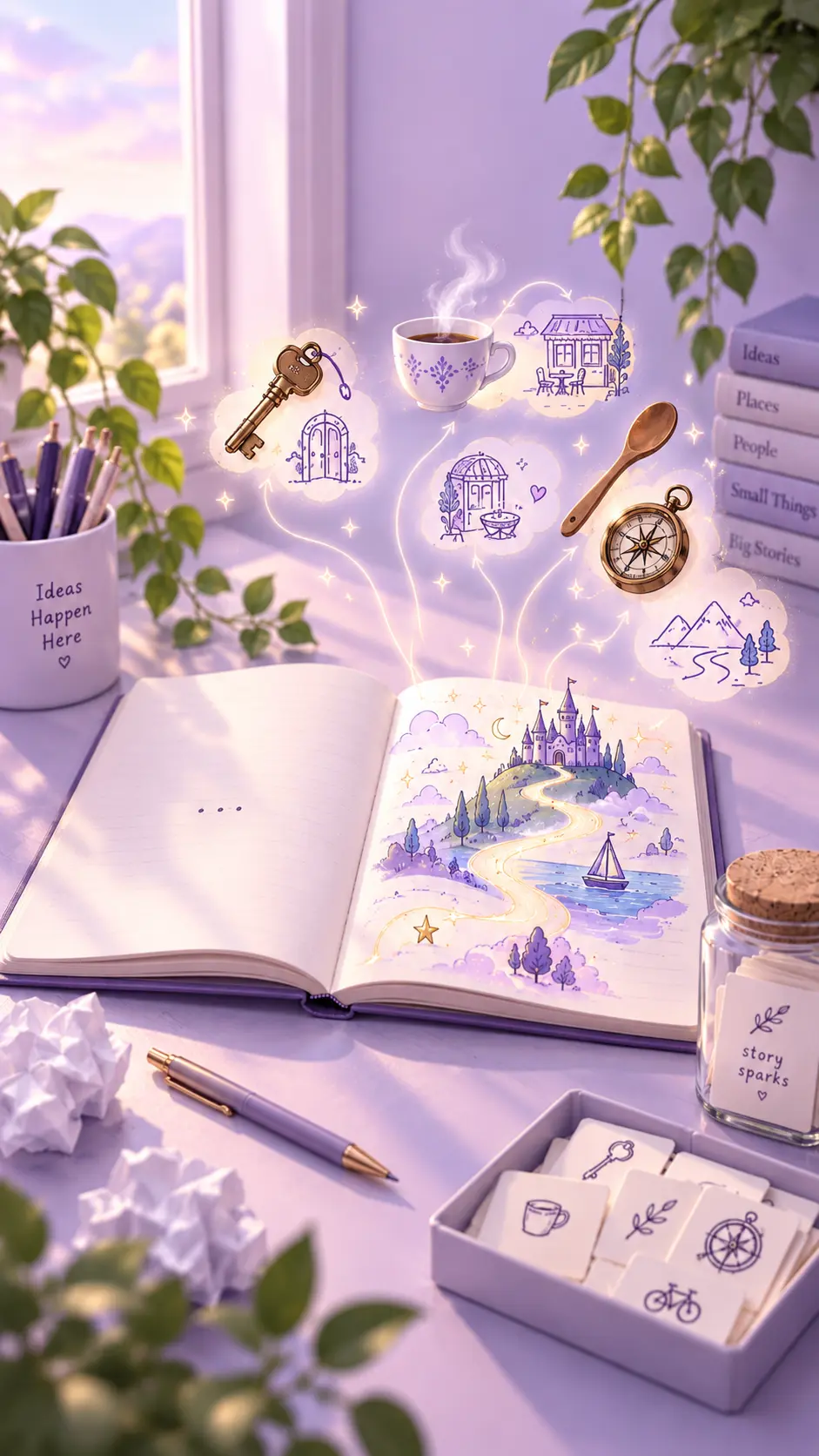
One of the fastest ways out of that stall isn’t to force a plot out of thin air, it’s to start with something you can actually hold onto: an object. A rusted key, a chipped teacup, a pair of muddy boots left by the door. These things carry weight before you’ve written a single line about them, because a physical detail already implies a history, an owner, and a reason it ended up wherever you found it. Pull a handful of items from a random object generator and your brain almost automatically starts asking who owns them and why they matter. That’s the whole trick behind this approach, a concrete detail gives you something real to build around instead of an empty page and a vague sense that you should probably write something.
This post walks through why the method works so well psychologically, how to actually turn a short list of objects into a real story with characters and stakes, and a few ways to push past the moment when you inevitably get stuck again partway through (because you will, and that’s completely normal). By the end, you’ll have a repeatable process you can return to anytime the blank page shows up, whether that’s for a short story, a scene you’re stuck on, or just a warm up exercise before you tackle the writing you actually meant to do that day.
Why Random Objects Work So Well for Storytelling
Constraints are strange like that. Tell someone to “write anything” and most people freeze, because anything is an impossibly large space to choose from and every option feels equally arbitrary. Hand that same person one odd object and a deadline, and a story practically writes itself. A random detail forces your brain to work backward: instead of inventing a whole world and hoping something interesting happens in it eventually, you’re simply explaining why this exact object exists and what it’s doing in someone’s hands right now.
Objects also give you something a vague prompt never can, texture. A story about “a family secret” is abstract, and abstract ideas are hard to start writing because there’s no image attached to them yet. A story about a locked box hidden under a floorboard isn’t abstract at all. Once the box exists, you start asking who locked it, what’s inside, and who’s been quietly avoiding that room for twenty years without ever saying why.
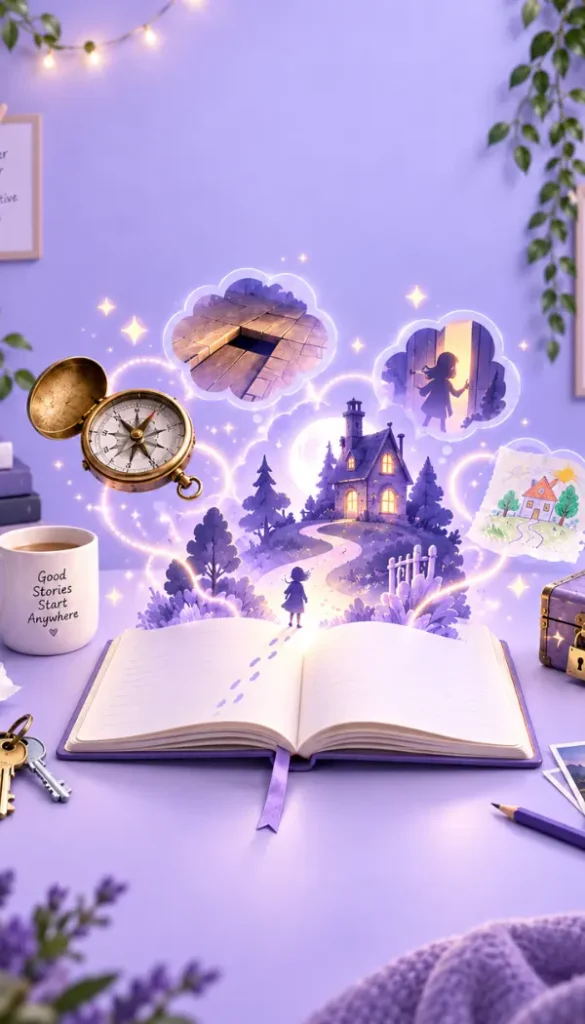
There’s a practical side to this too, beyond just the psychology of it. Sit down with three or four unrelated items, say a broken compass, a child’s drawing, and a set of keys that don’t match any lock in the house, and your mind naturally hunts for connections between them even when none seem obvious at first glance. That hunting instinct is basically what plotting is at its core, the search for how separate things relate to one another.
Building Your Story Step by Step
Start With a Handful of Objects
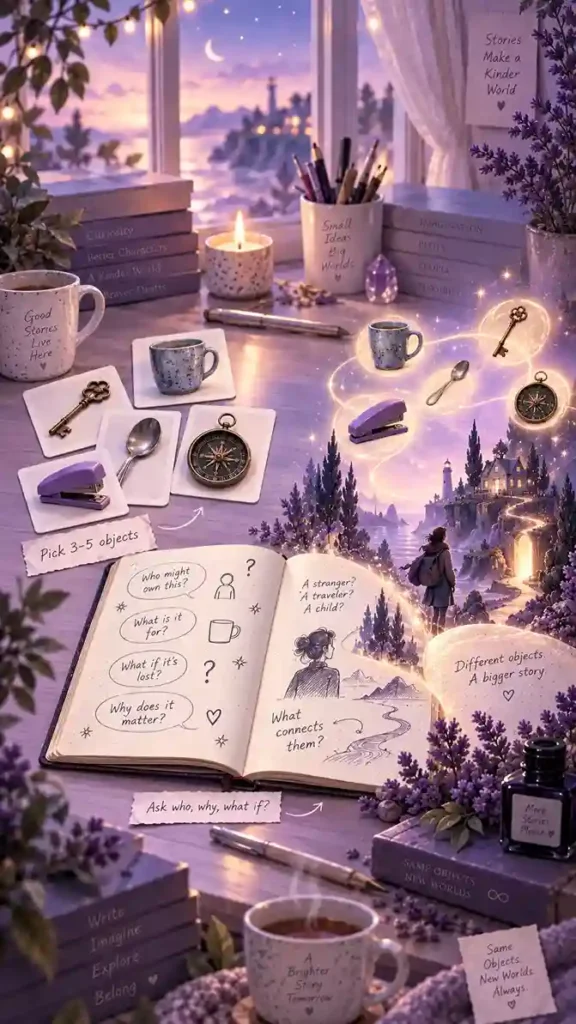
Generate anywhere from three to five items in one go, and try to resist the urge to cherry pick only the ones that already sound interesting. Part of the value here is working with things you wouldn’t normally choose for yourself, because your usual choices are exactly what led you to the blank page in the first place. If you land on something dull like a spoon or a stapler, keep it rather than throwing it back and rolling again. A dull object often makes the strangest one on your list feel even sharper by comparison, and ordinary items are frequently where the most relatable parts of a story end up living.
Ask Questions About Each Object
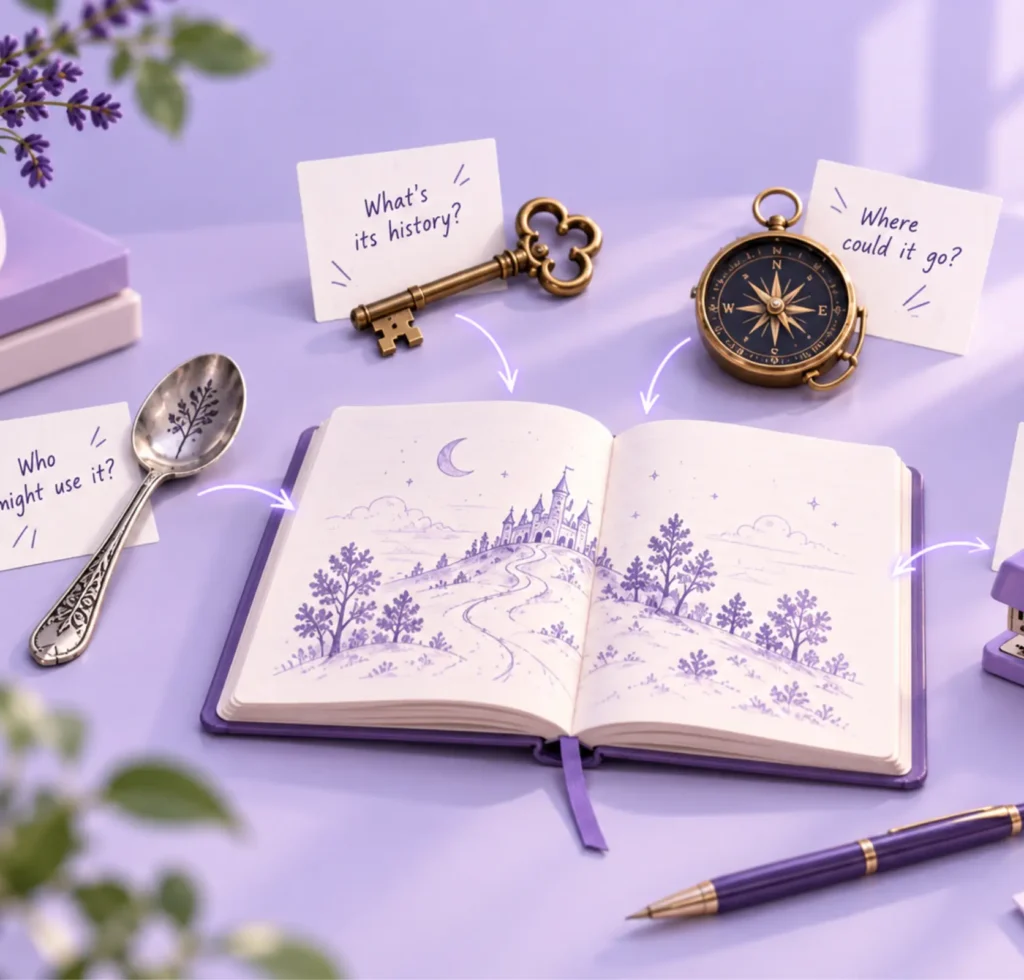
For each item on your list, ask who owns it, why they kept it, and what they’d do if it went missing tomorrow without warning. A single object rarely hands you a full story on its own, but the moment you give it an owner with something to lose, you’ve got a character and a stake in about two sentences flat. Do this same exercise with every item on your list and, more often than not, one connection between them will start to feel worth chasing, whether that’s a shared owner, a shared event, or one object that explains why the others matter at all.
Ready to rummage?
Spin up a batch of random objects right now — no sign-up, no waiting.
Quick Tips for Turning Objects Into Story Ideas
- Give the object a history before deciding what it does in the story.
- Let one object belong to your protagonist and another to someone they distrust.
- Ask what would happen if the object were stolen or destroyed tomorrow.
- Skip the obvious use for an item and try the opposite instead.
- Write the object’s backstory first, then figure out who’s holding it now.
- Combine two unrelated objects and force them into the same scene.
- Set a ten minute timer and write before deciding whether the idea works.
Why This Beats Staring at a Blank Page
The biggest advantage here isn’t the object itself, it’s the momentum that comes from having one. Starting with something specific lowers the stakes of that first sentence dramatically, because you’re not inventing an entire story out of nowhere, you’re just describing a thing and asking a question about it.
That’s a much smaller, much more manageable task, and small tasks are what actually get finished on the days when motivation isn’t showing up on its own. A lot of writers underestimate how much of “writer’s block” is really just the size of the first step being too large, and shrinking that step is often all it takes.
It’s also worth treating this as an ongoing habit rather than a one time trick you use only when you’re desperate. Keep a running list of objects you’ve generated but haven’t used yet, and pull from it whenever a scene stalls, a character feels flat, or a new project needs a spark to get going.
Teachers use it to design classroom writing exercises and warm ups, game designers use it to populate settings.
Writers who reach for random objects as writing prompts on a regular basis tend to build a kind of muscle memory for turning ordinary details into story material almost automatically, which makes the whole process noticeably faster every time they sit down to write, and eventually it stops feeling like a trick at all and starts feeling like how you write.
Good questions
Frequently asked
No, not at all. Generate more than you think you’ll need and let the weakest ones fall away naturally as you work. Some items just won’t spark anything no matter how long you stare at them, and that’s completely fine, move on to the next one rather than forcing a connection that isn’t there.
Three to five tends to be the sweet spot for most people. Fewer than that and you don’t have enough variety to find an interesting connection between items; more than that and it gets genuinely overwhelming to hold every possibility in your head at once while you’re trying to brainstorm.
Generate a fresh batch rather than forcing a story out of something that clearly isn’t clicking for you. It only takes a few seconds, and a completely new set of objects can shift your thinking faster than staring at the same unhelpful list for another ten minutes hoping something changes.
Yes, it scales in both directions pretty well. For short stories, one or two well chosen objects are often enough to anchor the entire piece from start to finish. For a novel, objects tend to work better as recurring symbols or as the seed for a single chapter, subplot, or character arc rather than the entire book’s plot.
Not at all. Teachers use it to design classroom writing exercises and warm ups, game designers use it to populate settings and prototypes with quick ideas, and plenty of people use it for journaling, brainstorming presentations, or just breaking out of repetitive thinking patterns that have nothing to do with fiction.
A typical prompt hands you a situation, theme, or emotion, which can still feel abstract and hard to picture right away. An object is physical and specific from the very first moment you look at it, so your brain has a lot less room to stay vague or stall out. That specificity tends to produce ideas faster and with more concrete, sensory detail baked in from the very first sentence you write.